Want to hear more from us?
SubscribeThe State of Volume Hiring 2026: key findings | Arctic Shores
Wednesday 20th May
-

-

-

- Subscribe
TL;DR
- Trust in hiring is collapsing on every side. Only half of candidates trust hiring managers to review them fairly. 35% of hiring managers aren't convinced candidates represent themselves honestly.
- Poor signal quality is doing more damage than application volumes. 39% of hiring managers say candidates who interviewed well couldn't do the job once hired. 87% of candidates say their CV represents them accurately. Only 51% of hiring managers agree.
- Everyone's coping strategy is making it worse. Ghosted candidates spray applications using AI. Overwhelmed recruiters resort to blunt filters. Hiring managers get shortlists they don't trust. The report maps this vicious cycle and how to break it.
Introduction
The State of Volume Hiring 2026 is the most important hiring research project Arctic Shores has ever conducted. In partnership with independent research firm Researchscape, we surveyed 1,105 job seekers and 564 hiring managers across the UK between February and April 2026, and conducted in-depth interviews with 10 senior talent acquisition leaders.
The report is 53 pages. This article covers the key findings.
Download your copy for free
Download the reportWhat did the research find?
Trust in the hiring process is collapsing. Not just among candidates. Among hiring managers and TA teams too.
Application volumes have surged, and 46% of candidates now use AI when applying for jobs. But volume is only the most visible problem. Underneath it, the signals that hiring processes rely on (CVs, application forms, interviews) are no longer producing information that either side trusts.
The report identifies three patterns driving this breakdown and introduces a framework, the Triangle of Trust, for understanding how efficiency, signal quality, and equity interact in volume hiring.
What is the Triangle of Trust?
The Triangle of Trust is a model for understanding what makes a volume hiring process work. It has three sides:
Efficiency: Does the process sift candidates at the speed and scale required?
Signal quality: Does the process surface authentic evidence of candidate ability?
Equity: Does the process give equal opportunity to all candidates?
When all three hold, candidates trust they'll get a fair shot, hiring managers trust they're seeing the right people, and TA teams trust the process will deliver. When one side weakens, the load shifts to the others. The research found that all three sides are currently under strain.
-1.png?width=697&height=440&name=Triangle%20of%20Trust%20(1)-1.png)
Source: Arctic Shores - The State of Volume Hiring 2026
What is the biggest driver of lost trust?
Signal quality. Despite the surge in application volumes, the most striking finding is that poor signal quality is doing the most damage to trust.
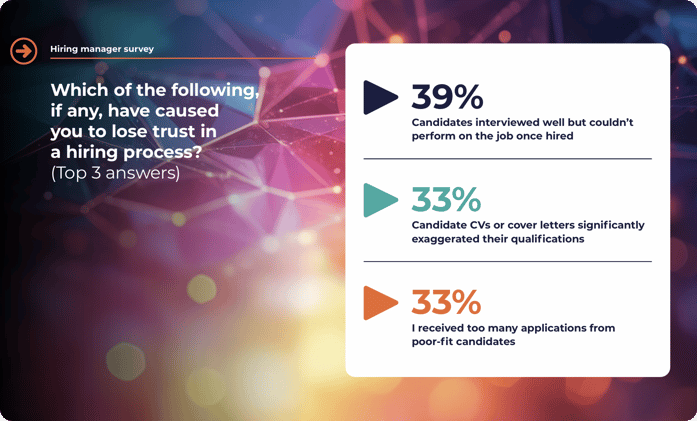
39% of hiring managers said candidates who interviewed well couldn't perform once hired. This was the single most common cause of lost trust. 33% said CVs significantly exaggerated qualifications. And 33% said they received too many applications from poor-fit candidates.
87% of candidates say their CV accurately represents their skills and experience. Only 51% of hiring managers agree.
Source: Arctic Shores - The State of Volume Hiring 2026
How are candidates using AI in hiring?
46% of candidates report using AI as part of the job application process. 12% use it extensively; 34% use it for some parts.
The most common uses: 42% have used or would use AI to help write a CV. 38% for cover letters. 37% for interview preparation. 27% for filling in applications. 15% for completing skills-based assessments.
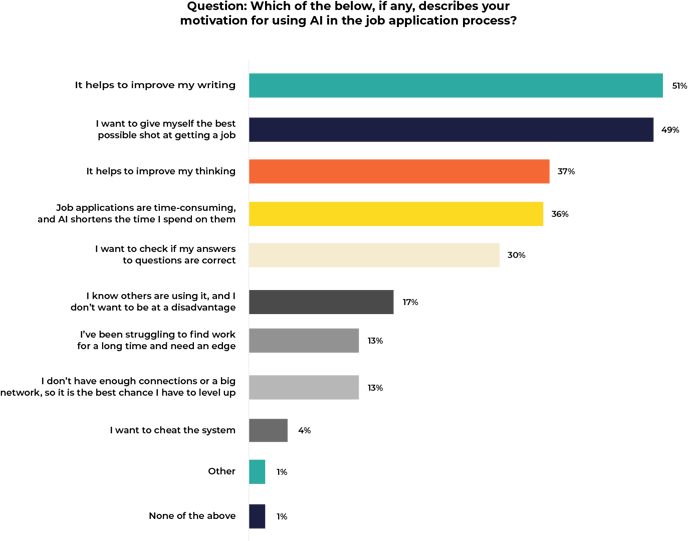
Only 4% of candidates say they use AI to cheat. The most common motivations are improving writing quality (51%), giving themselves the best possible shot at getting a job (49%), and improving their thinking (37%).
Usage varies by demographic. Black candidates are the most likely to say they use AI because they lack professional networks (20% vs 12% for White candidates). White candidates are less likely than Asian and Black candidates to use AI overall.
Source: Arctic Shores - The State of Volume Hiring 2026
Do candidates trust the hiring process?
Trust is low and unevenly distributed.
Only 40% of candidates trust that hiring processes generally identify the best candidates for roles. 51% trust hiring managers to review their application fairly and without bias. 48% aren't confident that recruiters work in their best interests.
Trust also fractures along demographic lines. Women are more likely than men to say their applications aren't being fairly reviewed (40% vs 32%). Candidates from lower-income households are the most likely to say their skills and potential aren't being effectively evaluated (42% vs 36% average).
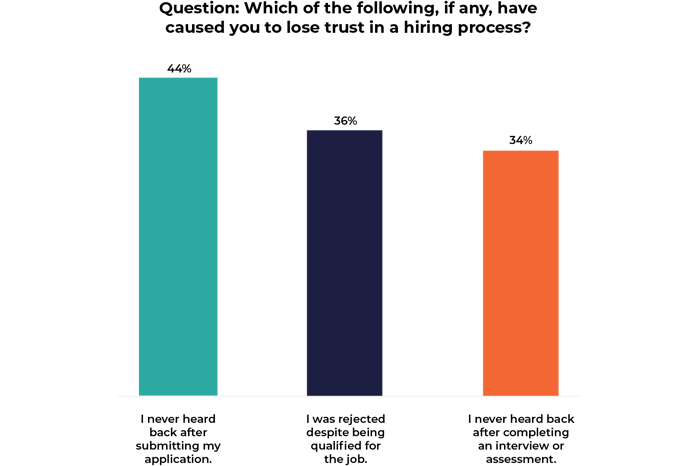
44% of candidates say they never heard back after submitting an application. 36% were rejected despite believing they were qualified. 34% never heard back after completing an interview or assessment.
Source: Arctic Shores - The State of Volume Hiring 2026
Do hiring managers trust the hiring process?
Hiring manager trust is also strained. 35% aren't convinced candidates represent themselves honestly. Only 2 in 3 trust recruiters to send them qualified candidates.
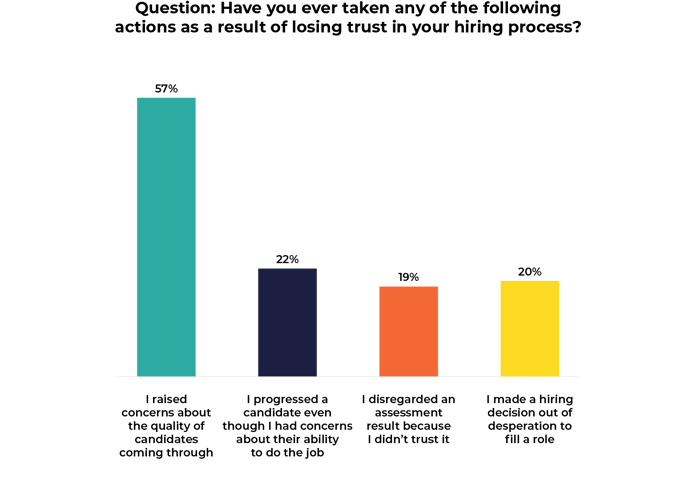
57% have raised concerns about the quality of candidates coming through. 22% progressed a candidate despite having concerns about their ability. 19% disregarded an assessment result because they didn't trust it. 20% made a hiring decision out of desperation to fill a role.
Source: Arctic Shores - The State of Volume Hiring 2026
What happens when trust breaks down?
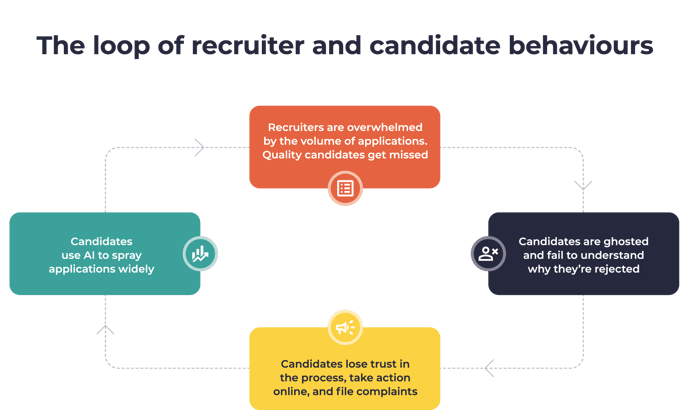
The research identified a vicious cycle. Each group's response to pressure makes the experience worse for the others.
Candidates who are ghosted or rejected without explanation respond by applying more widely and aspirationally, often using AI. Recruiters, overwhelmed by near-identical applications, resort to shortcuts and blunt filters. Hiring managers inherit shortlists full of candidates who look stronger on paper than in practice, and begin questioning whether the process works.
23% of candidates have withdrawn an application after a negative experience. 19% declined a job offer. 15% warned others not to apply. Gen Z candidates are significantly more likely to take all of these actions.
Source: Arctic Shores - The State of Volume Hiring 2026
Want to see the full data set?
Download the reportWhat signals do hiring managers and candidates trust most?
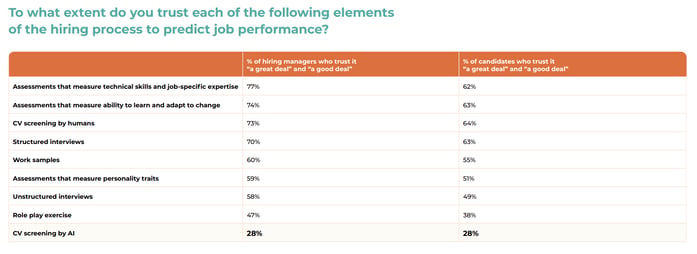
Both groups were asked which elements of the hiring process they trust to predict job performance.
The highest-trust signals among hiring managers: assessments measuring technical skills (77%), assessments measuring ability to learn and adapt to change (74%), and CV screening by humans (73%).
The highest-trust signals among candidates: CV screening by humans (64%), structured interviews (63%), and assessments measuring ability to learn and adapt (63%).
Both groups rank AI CV screening at the bottom, at exactly the same level: 28%.
74% of hiring managers trust assessments that measure the ability to learn and adapt to change. Gen Z candidates are the most likely to trust this type of assessment (68% vs 63% average).
Source: Arctic Shores - The State of Volume Hiring 2026
How do candidates prefer to demonstrate their capabilities?
35% prefer talking about their capabilities. 29% prefer completing practical tasks. 25% prefer writing about them.
The preference for practical tasks is strongest among Black candidates (42% vs 29% average).
What should TA teams do?
The report recommends three steps:
-
Make candidates feel seen. Be transparent at every stage about what comes next, what you're looking for, and how decisions are made. Candidates who understand what they're being assessed on engage more authentically and produce better signals.
-
Get robust signals throughout the funnel. At the top, where volume is highest, prioritise AI-resilient behavioural and cognitive signals: evidence of how candidates actually think and approach problems. Through the funnel, audit every stage for opportunities to evaluate actions, not just answers.
-
Design for fairness first. Build explainable, objective, evidence-backed methods into every stage. Set high benchmarks early to manage volume, but validate that they don't create adverse impact for underrepresented groups. In an evolving regulatory environment, a process you can't explain is a process you can't protect.
What is the regulatory context?
The Information Commissioner's Office published new guidance on automated decision-making in recruitment on 31 March 2026, underpinned by the Data (Use and Access) Act 2025. The guidance permits automated decision-making in recruitment provided safeguards are in place: transparency about how tools are used, valid and explainable assessment methods, and the right for candidates to request human review.
78% of candidates said companies should disclose if they use AI in the hiring process. Only 10% of organisations with an AI policy have made it public-facing.
Download the full report
The State of Volume Hiring 2026 is free to download. The report includes all survey data, TA leader interviews, the Triangle of Trust framework, and practical guidance for rebuilding trust in volume hiring.